
Delaware Property Records
Delaware property records are public documents held by the Recorder of Deeds in each of the state's three counties. New Castle, Kent, and Sussex each maintain their own land records system covering deeds, mortgages, liens, plats, and other instruments that affect real estate ownership. Whether you need to search a deed, trace a title, verify current ownership, or look up assessment information, you can access Delaware property records online through each county's official portal or visit the recorder's office in person. Index searching is free in all three counties, and document images are available online.
Delaware Property Records at a Glance
How Delaware Property Records Work
Delaware runs its land records through three elected county recorders. Each serves a four-year term. Under Delaware Code Title 9, Chapter 96, the recorder must record all deeds, mortgages, mortgage releases, powers of attorney, plats, financing statements, and other land-related instruments within a reasonable time after they are lodged for recording. The recorder then makes note of each document in the proper indices. This creates a continuous paper trail for every parcel in the state, stretching back in some cases to before Delaware was a state.
The recorder cannot accept a document unless it meets certain requirements. The county tax assessment parcel identification number must appear on the instrument. The words "prepared by" must appear on the first page, followed by the name and address of the person who drafted the document. These rules protect the integrity of the public record and help link each instrument to the correct parcel in the county assessment database. Format standards also apply. Documents that don't meet size or margin requirements may need an attached statement identifying the parties, the property, and the nature of the instrument to ensure proper archiving and future retrieval. Delaware law does not allow recorders to knowingly record any document that contains language restricting the sale, transfer, or occupancy of real property based on race, religion, sex, disability, age, familial status, national origin, or any other protected class under the state's fair housing code.
Deeds are never changed once recorded. That's worth understanding. If you need to correct an error or update ownership, you make a new deed and record it alongside the original. This builds what recorders call a chain of title, and that chain can stretch back centuries in Delaware.
The Delaware Public Archives holds historical land records from all three counties when older volumes become too worn for regular public use. The State Archivist makes photocopies and certifies them as complete before returning them to researchers. Historic deeds dating to the 17th century are available for research at the Archives building at 121 Martin Luther King Jr. Boulevard North in Dover.
The Delaware Code Title 9, Chapter 96 page, shown below, is the full legal source for recorder duties, salaries, recording obligations, redaction authority, and the rules that govern how each county office operates.
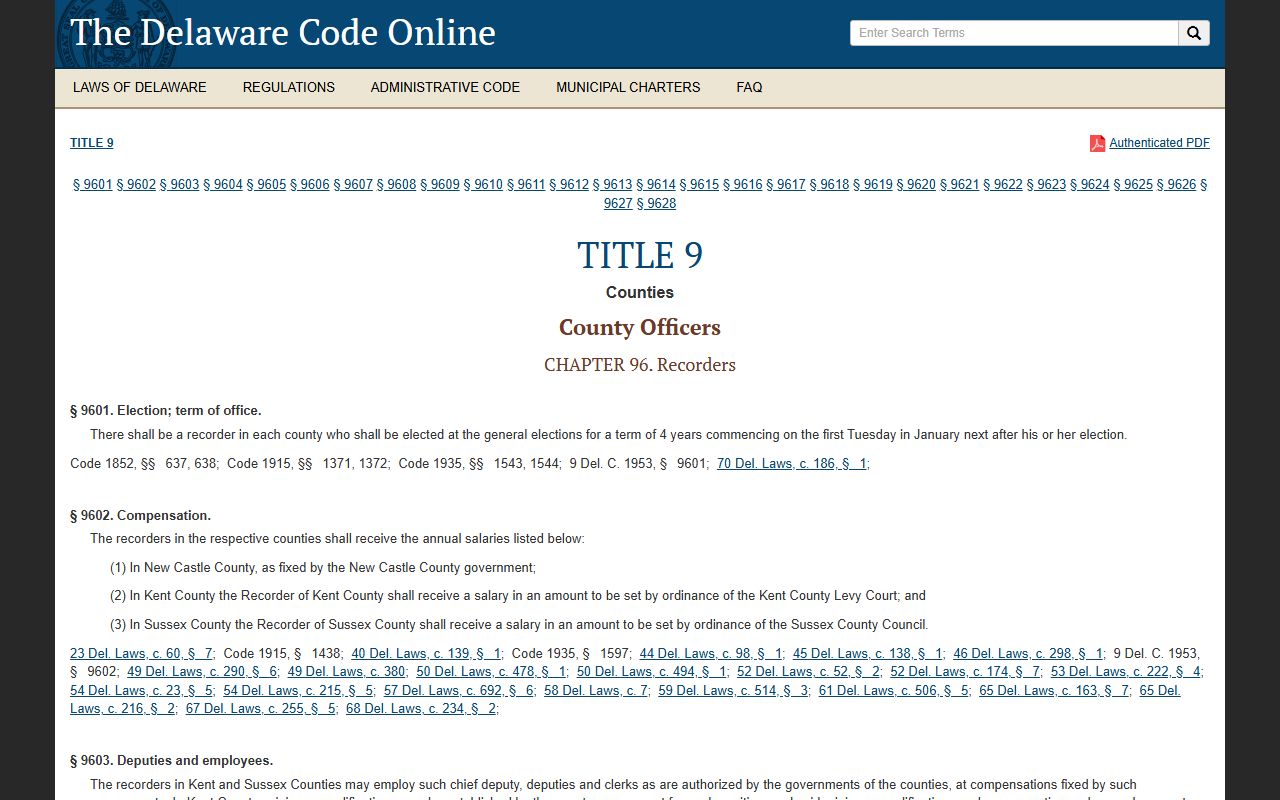
Chapter 96 sets out recorder salaries, recording timelines, what documents must be accepted, and the rules for redacting personal identifying information from previously recorded instruments.
Finding Delaware Property Records Online
All three Delaware counties use an online platform powered by Avenu Insights through the US Land Records system. You can search by grantor name, grantee name, document type, date range, book and page number, or instrument number. Index searching is completely free. Document images can be viewed with a watermark at no charge. To download or print a clean copy, you pay $2.00 per page. Frequent users can subscribe for $75 per month for unlimited access. The Kent County portal at i2g.uslandrecords.com/DE/Kent2 covers records certified from January 30, 1874 to the present. Sussex County's search is at i2g.uslandrecords.com/DE/Sussex2. New Castle County provides online access through newcastlede.gov.
Searching by name requires a bit of care. Names are indexed as written on the legal document. For corporations, government entities, churches, and cemeteries, the recorder uses specific indexing conventions. Kent County's website provides indexing standards to help users understand how non-human entities are listed. When searching for a company or organization, try multiple name variations if you don't find results on the first try. The site uses pop-ups for printing and downloading, so you'll need to allow pop-ups in your browser. Adobe Reader is also required for document printing and downloading.
Kent County also runs a separate property records system through the Kent County Levy Court. That portal includes ownership data, sales prices, transfer dates, legal descriptions, land and building details, and assessment history. It uses an interactive map interface and lets you search by address, owner name, or parcel ID number. This is different from the deed search portal and covers tax assessment information rather than recorded instruments.
The Delaware State Government Portal, shown below, links to all state agencies including the county recorders, Division of Revenue, and Public Archives, making it a useful starting point when you're not sure which office handles what you need.
The portal at delaware.gov connects to every state agency and department, including property tax, recorder offices, courts, and the legislature.
For records before the online era, the Delaware Public Archives, shown below, holds historical volumes and lets researchers access them in the Mabel Lloyd Ridgely Research Room in Dover.
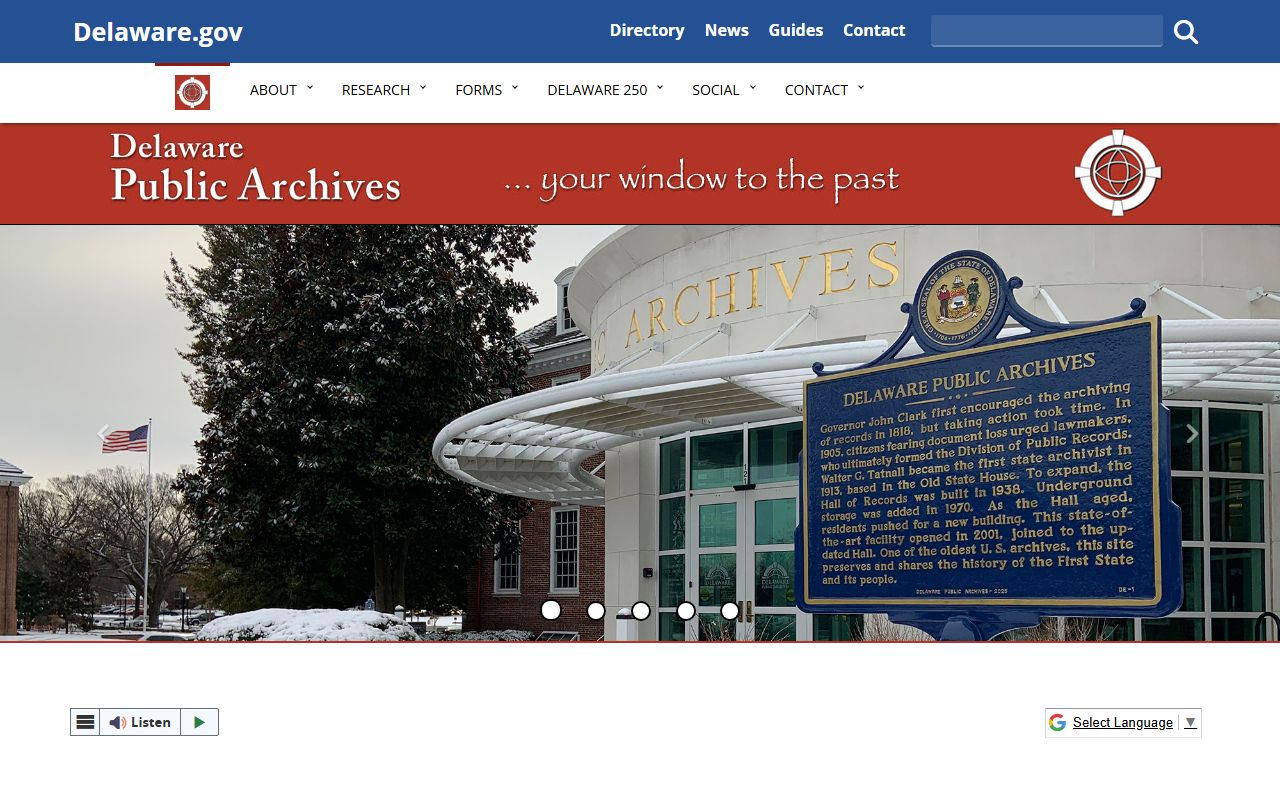
The Archives at 121 Martin Luther King Jr. Boulevard North holds certified copies of all county deed volumes that have been retired from active use, some dating to the 1600s.
Note: Every deed or instrument filed with any Delaware county recorder must include the county tax assessment parcel identification number on the document or it will not be accepted for recording.
Delaware Property Law and Recording Requirements
Title 25 of the Delaware Code governs all aspects of property law in the state. It covers deeds, mortgages, landlord-tenant relationships, agricultural leases, manufactured home communities, and common interest ownership. Part I of Title 25 addresses general provisions. Parts II through VII cover mortgages and liens, the Residential Landlord-Tenant Code, commercial leases, agricultural leases, manufactured home communities, and common interest real estate respectively. This title is the legal backbone for every property transaction in Delaware.
Chapter 1 of Title 25 covers deeds specifically. Lands and tenements may be transferred by deed without livery of seisin. A married woman's deed executed during coverture is valid if properly acknowledged. If a conveyance is absolute on its face but there is a defeasance contract, the person receiving the conveyance must record a note stating the general purport of that defeasance within 60 days after the agreement is made. A deed or letter of attorney acknowledged and certified according to chapter requirements may be recorded in the recorder's office for the county where the lands are located. Once recorded, the record or an office copy serves as sufficient evidence. Deeds can be recorded at any time after sealing and delivery, as long as they are properly acknowledged.
Delaware enacted a new property instrument in 2025. The Transfer on Death Deed allows owners to name a beneficiary to receive real estate at death without probate. More on this is covered below.
The Title 25 overview page, shown below, is the starting point for reading any Delaware property statute in full.
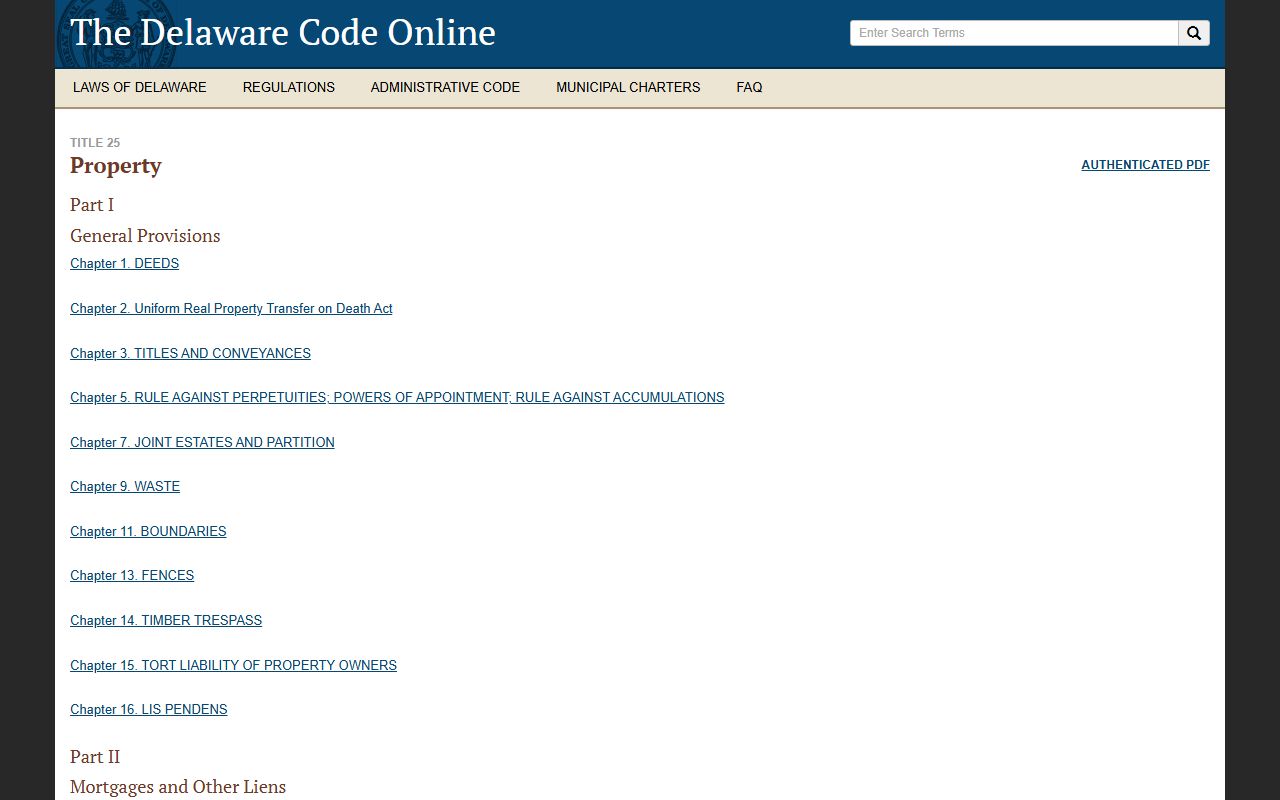
Title 25 of the Delaware Code covers every major aspect of property ownership, transfer, and recording in the state, from basic deed rules to manufactured home community regulations.
The Chapter 1 deeds page, shown below, covers the specific rules that apply to every deed recorded in Delaware, including requirements for married women, defeasance, and chain of title.
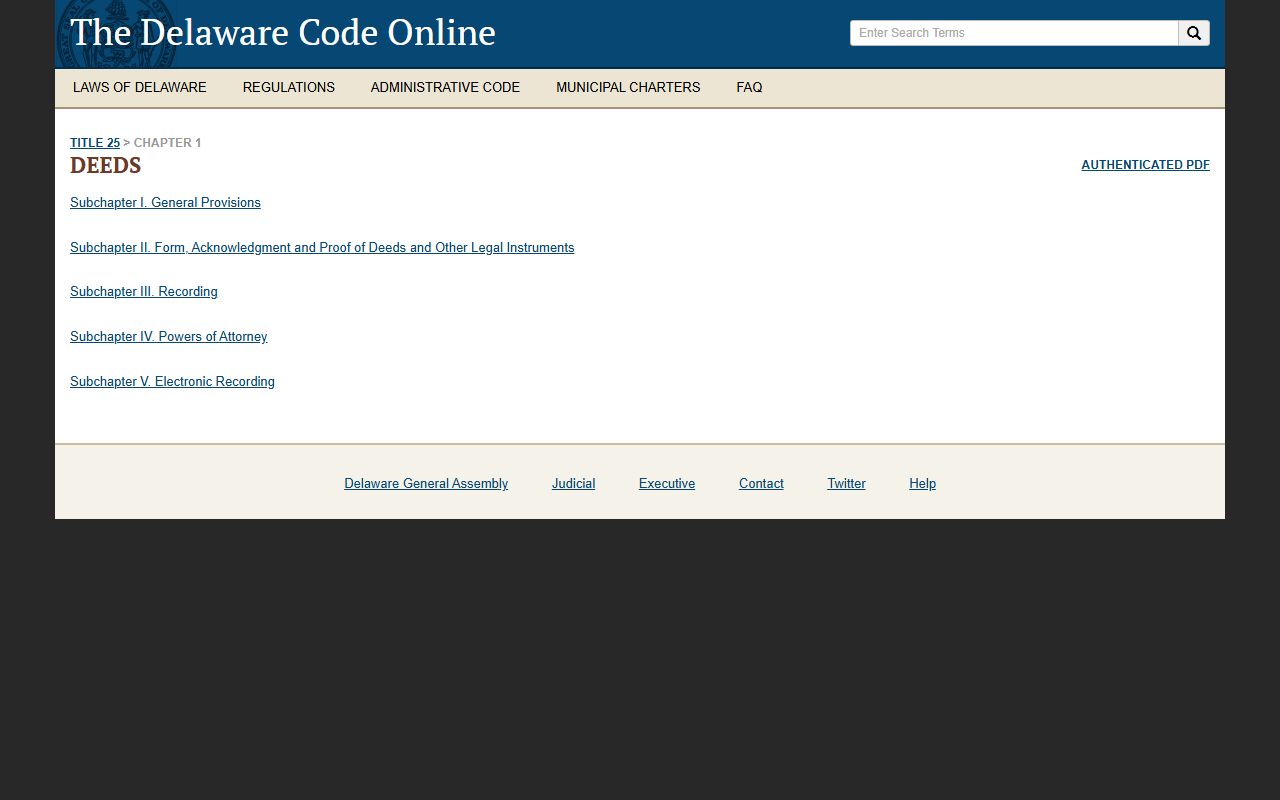
Chapter 1 is the section that governs how every deed in Delaware must be written, acknowledged, and recorded to be enforceable and admissible as evidence.
Delaware Realty Transfer Tax
Every real estate sale in Delaware triggers the Realty Transfer Tax under Title 30, Chapter 54. The tax applies at the time of recording. The standard rate is 3 percent of the property's value, and it is split equally between the buyer and seller at 1.5 percent each. If the local jurisdiction where the property sits has also enacted its own 1.5 percent local transfer tax, the state rate drops to 2.5 percent. The combined rate in that case is still 4 percent total. The tax is paid when the deed is presented for recording at the county recorder's office. Failure to pay the full amount at recording is a violation subject to fines up to $500 and up to one year of imprisonment under the Delaware Superior Court's jurisdiction. The Delaware Division of Revenue administers the tax through the county recorder system using a documentary stamp process.
First-time home buyers can reduce their share of the tax. For purchases made on or after August 1, 2017, the buyer's portion is reduced by half a percent on the first $400,000 of value. Both spouses must qualify as first-time buyers if purchasing jointly. Neither can have held any direct legal interest in residential real estate before. The buyer must also plan to occupy the property as a primary residence within 90 days of the transaction. The seller's portion is not reduced. Tax receipts go 75 percent to the Delaware Division of Revenue and 25 percent to the State Treasurer for distribution to counties and municipalities based on pro rata allocations set by law. New Castle County receives 44.48 percent of that distributed share. Sussex County receives 11.94 percent. Kent County receives 7.12 percent. The City of Wilmington receives 16.555 percent.
Exempt transactions include conveyances between spouses, between parent and child, between siblings, to nonprofit organizations under Section 501(c)(3), to religious organizations not used for commercial purposes, to volunteer fire companies, to land banks, and gifts without consideration. These exemptions apply regardless of the property's value.
The Title 30 Chapter 54 page, shown below, contains the full text of the Realty Transfer Tax statute including all exemptions, first-time buyer provisions, distribution rules, and penalty provisions.
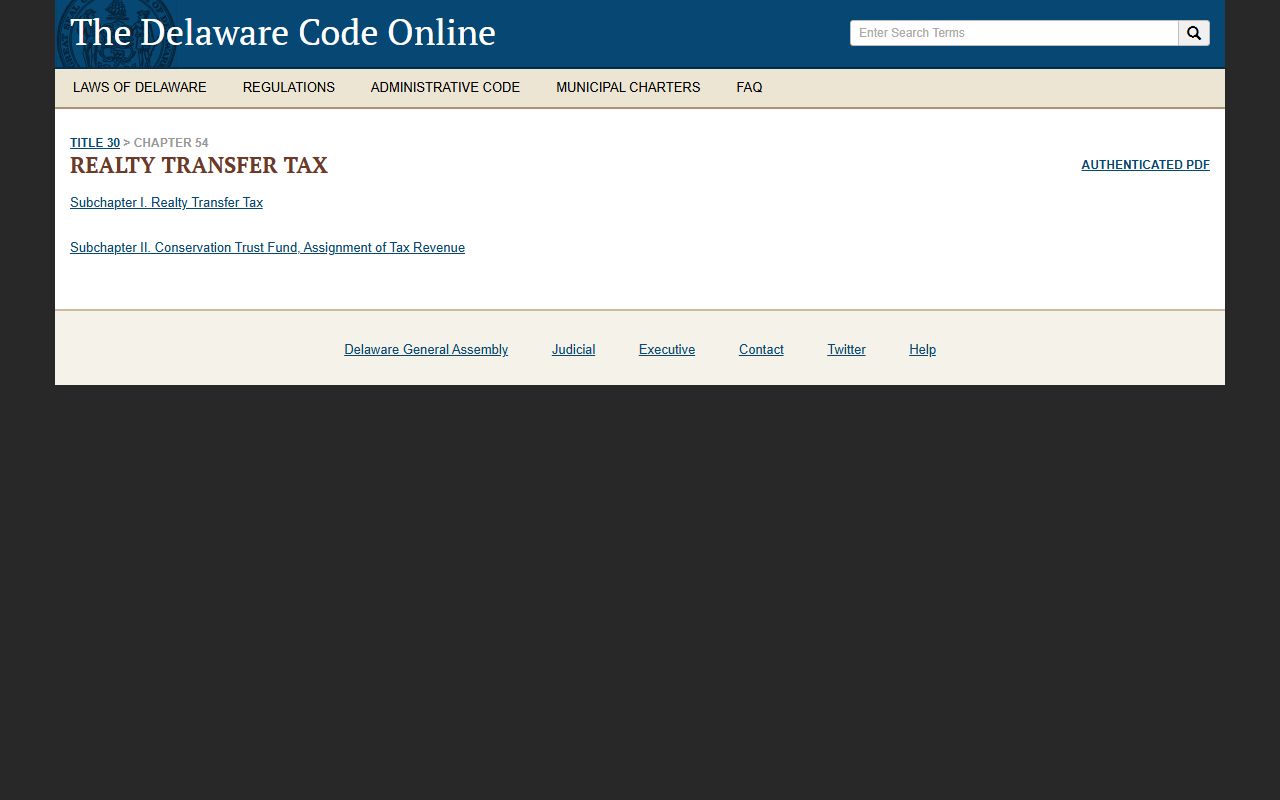
Every taxable property transfer in Delaware is governed by Title 30 Chapter 54. Reading this chapter answers questions about rates, exemptions, who pays, and how the tax is collected and distributed.
The Delaware Division of Revenue, shown below, collects the transfer tax through the recorder offices and manages the documentary stamp system used in every applicable transaction.
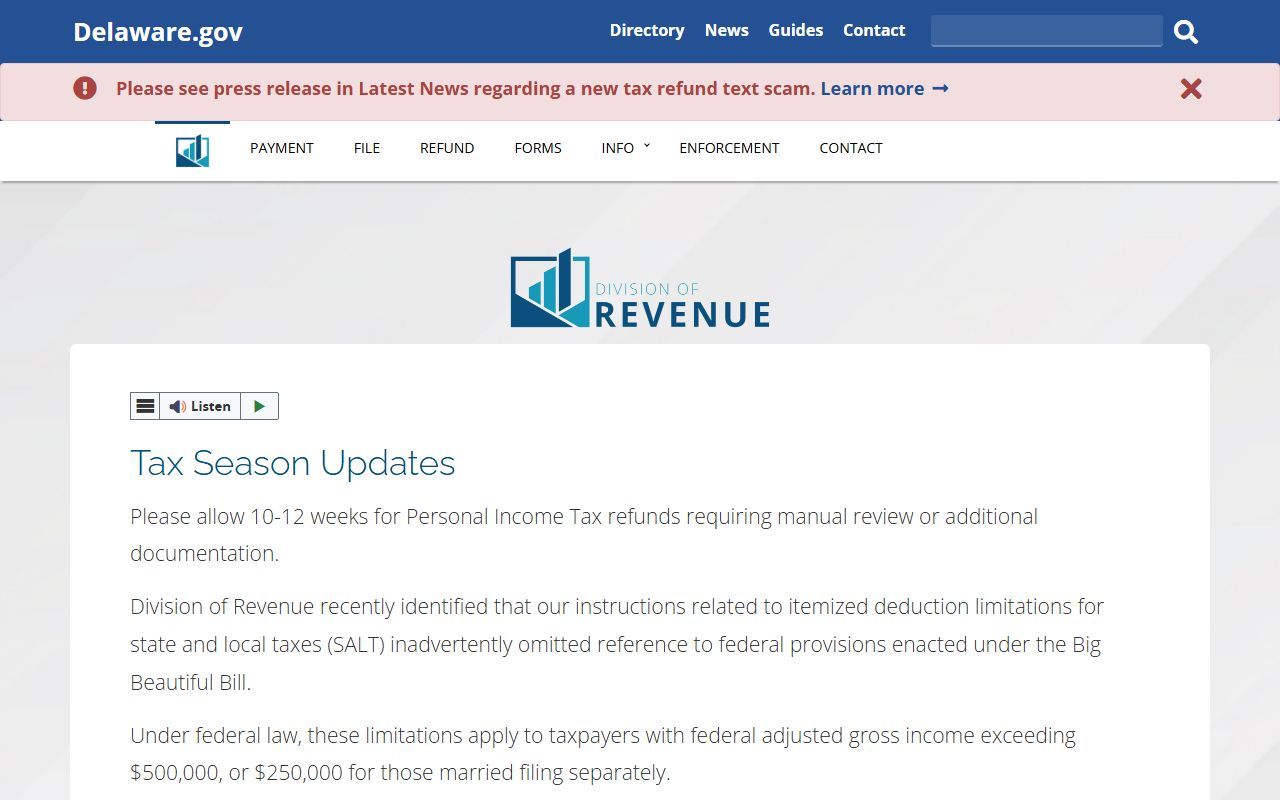
The Division of Revenue prepares and furnishes documentary stamps and can appoint county recorders as agents for stamp sales to facilitate tax collection at the point of recording.
Note: First-time home buyers in Delaware may qualify to reduce their share of the Realty Transfer Tax by half a percent on up to $400,000 of property value for purchases made after August 1, 2017.
Transfer on Death Deeds in Delaware
Delaware enacted the Uniform Real Property Transfer on Death Act in 2025, codified in Title 25, Chapter 2. The law lets property owners designate a beneficiary to receive real estate at death without going through probate. The owner keeps complete control of the property while alive and can sell it, mortgage it, or revoke the transfer at any time before death. The designated beneficiary has no legal interest in the property until the owner dies. During the owner's lifetime, the Transfer on Death Deed does not create any rights in the beneficiary's favor, does not affect the owner's eligibility for public assistance, and does not give creditors of the beneficiary any claim against the property. The Sussex County Recorder of Deeds was among the first offices in Delaware to accept these instruments after the state senate unanimously passed HB147 on June 30, 2025. Kent County's recorder also provides forms and fact sheets to help property owners understand and use this new option.
To be valid, a Transfer on Death Deed must meet all regular deed requirements and be notarized. It must also be signed by two witnesses, at least one of whom is not a named beneficiary. The deed must clearly state that the transfer occurs at the transferor's death. Most importantly, it must be recorded in the county recorder's office before the transferor's death. A TODD that is not recorded before the owner dies has no effect. The Kent County Recorder of Deeds describes this as a low-cost, simple alternative to a Will when an estate consists mainly of real property.
The Transfer on Death Deed Act page, shown below, contains the full statute including creation requirements, revocation rules, beneficiary rights, and how TODDs interact with mortgages, liens, and other encumbrances on the property at the time of the owner's death.
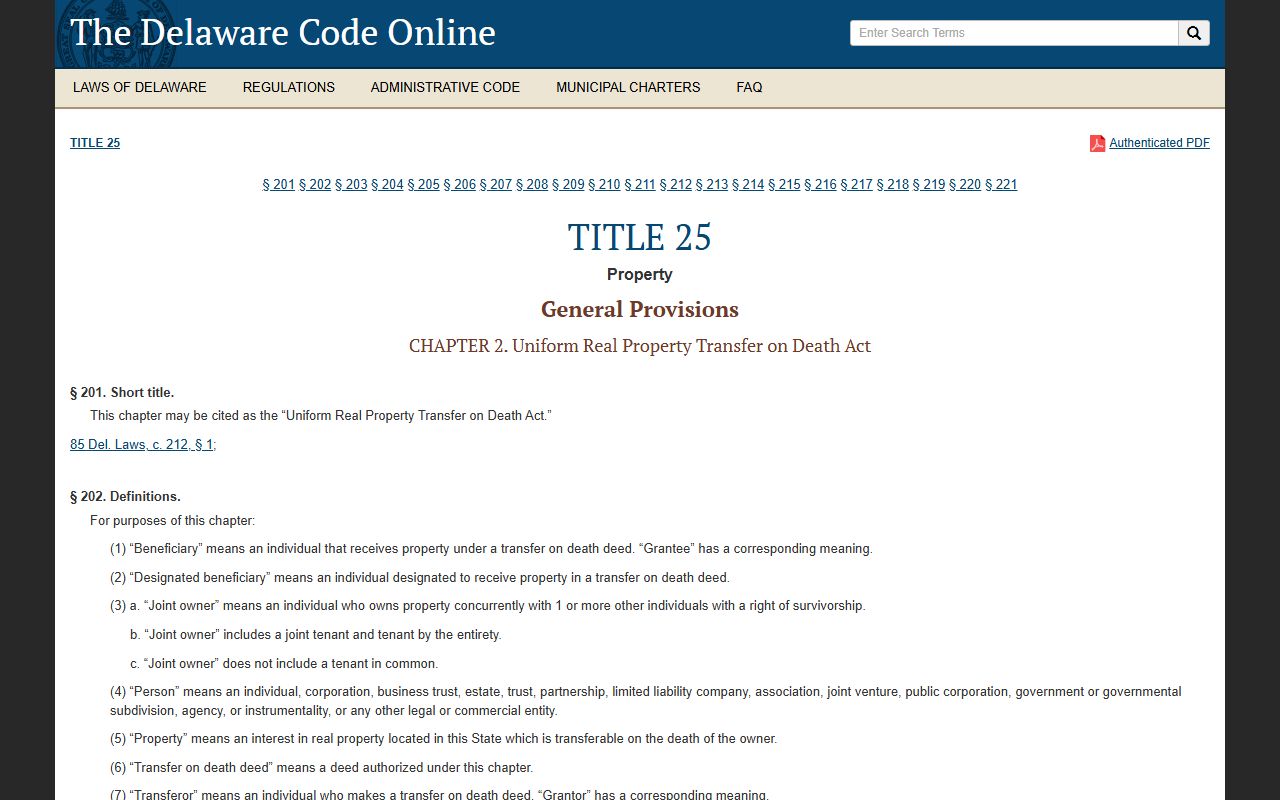
Chapter 2 of Title 25 is the full text of the Transfer on Death Deed Act enacted in 2025, covering every requirement for creation, recording, revocation, and the rights of beneficiaries upon the transferor's death.
Fair Housing Protections and Property Documents
Under Delaware Code Title 6, Chapter 46, the Delaware Fair Housing Act prohibits discriminatory restrictions in property documents. No recorder may knowingly accept for recording any deed, mortgage, contract, or other instrument affecting real property that contains any promise, covenant, or restriction limiting the sale, transfer, ownership, lease, rental, use, or occupancy of real property based on race, color, creed, religion, sex, sexual orientation, gender identity, disability, age, marital status, familial status, source of income, national origin, ancestry, or housing status. Such language is void and unenforceable even if it appears in a document that was legally recorded years or decades ago. The Fair Housing Act also prohibits discrimination in the terms and conditions of any property sale or rental and requires that multifamily dwellings be designed with accessible features to accommodate persons with disabilities.
If discriminatory language appears in your chain of title, you can request redaction. Delaware law authorizes recorders to redact unlawful restrictive covenants upon written request. Recorders can also redact personal identifying information such as bank account numbers, the first five digits of a social security number, driver's license numbers, alien registration numbers, and passport numbers from previously recorded instruments. This protects prior signatories from identity exposure in public records without affecting the legally essential information like party names, property descriptions, parcel numbers, and mailing addresses.
The Delaware Fair Housing Act page, shown below, is the full statute covering all protected classes, prohibited actions, and the administrative process for resolving housing discrimination complaints.
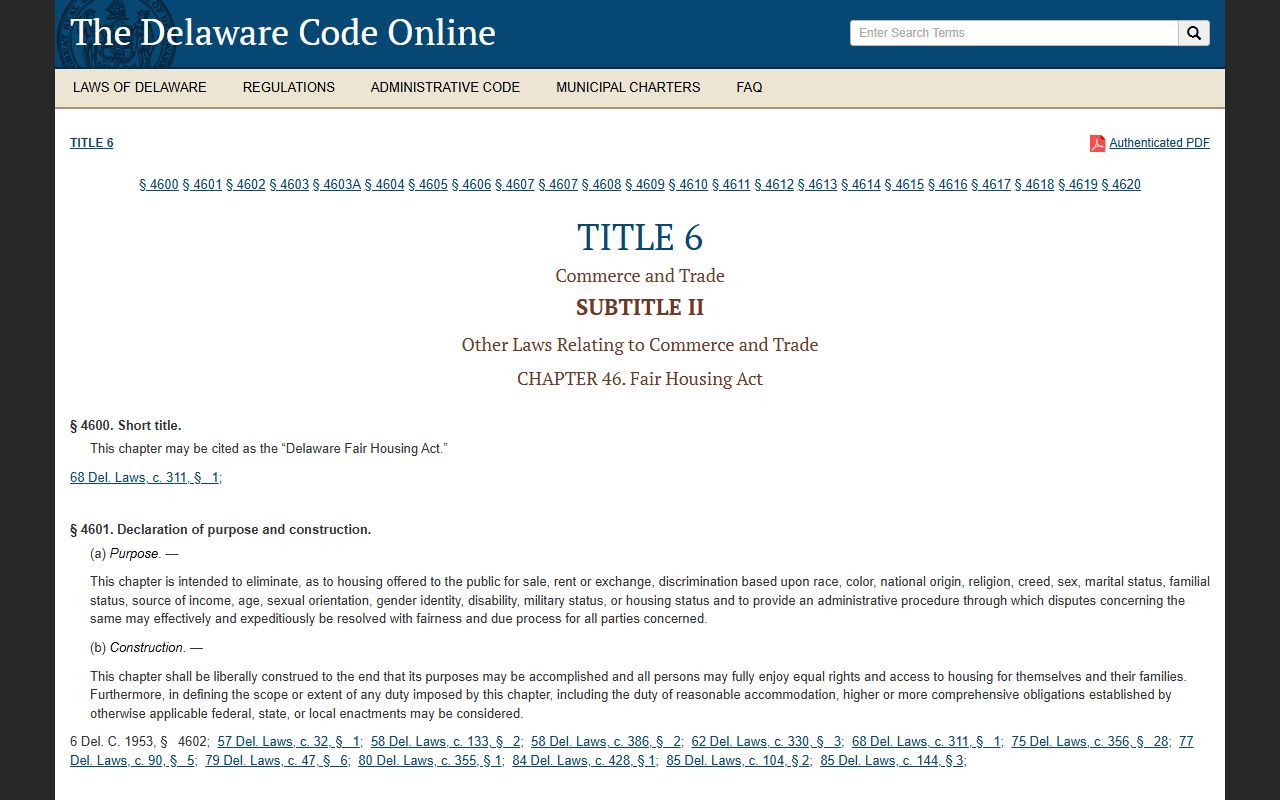
Title 6 Chapter 46 governs fair housing protections in Delaware, including the rules that make discriminatory deed covenants void and unenforceable regardless of when they were recorded.
Delaware Courts and Property Record Laws
The Delaware Superior Court has jurisdiction over criminal and civil cases related to property, including violations of the Realty Transfer Tax. The court operates in all three counties: at the Leonard L. Williams Justice Center, 500 North King Street, Wilmington (New Castle County); at the Kent County Courthouse, 38 The Green, Dover (Kent County); and at the Sussex County Courthouse, 1 The Circle, Suite 2, Georgetown (Sussex County). Anyone who makes, executes, accepts, or presents a deed for recording without paying the full transfer tax, or who fraudulently uses or alters documentary stamps, faces fines of up to $500 and up to one year of imprisonment under the court's jurisdiction. The Superior Court also serves as an intermediate appellate court for decisions made by more than 50 administrative agencies, including those with oversight over property-related matters.
The Delaware Legislature is the source of all property recording statutes. The General Assembly has 21 senators and 41 house members. They meet each year beginning the second Tuesday of January. Laws governing deeds, recorders, transfer taxes, and the new Transfer on Death Deed all originated in this body. You can search bills, track current legislation, and access the full Delaware Code through the legislature's website. Keeping an eye on the legislature is the best way to stay current on any changes to recording requirements or tax rules.
The Delaware Superior Court, shown below, has offices in all three counties and handles property-related matters including transfer tax enforcement and appeals from property-related administrative decisions.
The Superior Court's three locations cover New Castle, Kent, and Sussex counties and hear cases involving Realty Transfer Tax violations and appeals from administrative decisions related to property.
The Delaware Legislature, shown below, is where all property laws are made. The site lets you search bills, access the full Delaware Code, and track any legislative changes that affect recording requirements or property taxes.
The Delaware Legislature's website provides searchable access to all Delaware statutes, including Title 9 (Recorders), Title 25 (Property), Title 30 (Transfer Tax), and Title 6 (Fair Housing).
Browse Delaware Property Records by County
Delaware has three counties, each with its own Recorder of Deeds. Property records are filed in the county where the land is located. Pick a county below for contact information, search tools, fees, and local resources.
Property Records in Major Delaware Cities
Property deeds and land records in Delaware cities are filed with the county recorder for the county where the city sits. Select a city below for courthouse details, local office information, and how to search property records in that area.