
Search Property Records in Milford
Milford property records are split between two counties, making this city unique in Delaware. Whether you need a deed, an assessment record, or a transfer history, you must first know which side of the county line your property sits on before you can search the right office.
Why Milford Property Records Are Split
Milford sits right on the boundary between Kent and Sussex counties. This is not a technicality. It has real consequences for anyone trying to find property records. The county line runs through the city, and the side of that line your parcel falls on determines which recorder of deeds holds the documents you need. No single office has records for all of Milford. You have to go to two different agencies, in two different cities, depending on where the property is located.
The City of Milford operates under a council-manager government. The city has its own planning and building departments, but it does not record deeds. Recording is a county function in Delaware, and Milford's split position means both Kent County and Sussex County play a role. Properties on the north and west tend to fall in Kent County. Properties on the south and east tend to fall in Sussex. But those are generalizations. You should not guess based on location alone.
If you are unsure which county a property is in, the city's planning department can help. The Planning and Zoning Department maintains the official zoning map and can identify which county a parcel belongs to. You can also look up the parcel number and check it against county mapping tools. Getting the county right before you search saves time and frustration.
Property assessments follow the same split. Kent County assesses properties on its side. Sussex County assesses properties on its side. If you need tax assessment data for a Milford parcel, you will deal with whichever county holds it. There is no combined city assessment roll.
Kent County Recorder of Deeds (North/West Milford)
For properties on the Kent County side of Milford, the Recorder of Deeds is in Dover. The office is led by Honorable Eugenia Thornton and is located at 555 Bay Road, Dover, DE 19901. You can reach the office by phone at 302-744-2314 or by email at Recorder@kentcountyde.gov. Regular office hours run from 8:00 AM to 5:00 PM on weekdays, but the recording window closes at 3:00 PM. If you need to submit a document for recording, plan to arrive well before 3:00 PM.
The Kent County Deeds Office maintains deed records going back to January 30, 1874. You can search the index online for free through the Kent County online search portal. Searching is free. Document downloads cost $2.00 per page, or you can pay $75 per month for a subscription that gives you unlimited access. Most people doing a one-time search will pay per page.
The Kent County resident property records page links to additional resources including deed searches and information about how records are organized. It is a good starting point if you are new to searching Kent County records.
The Kent County Recorder of Deeds handles property records for the Kent County side of Milford, including deeds, mortgages, and subdivision plats. The office is located in Dover and offers online access through the US Land Records portal.
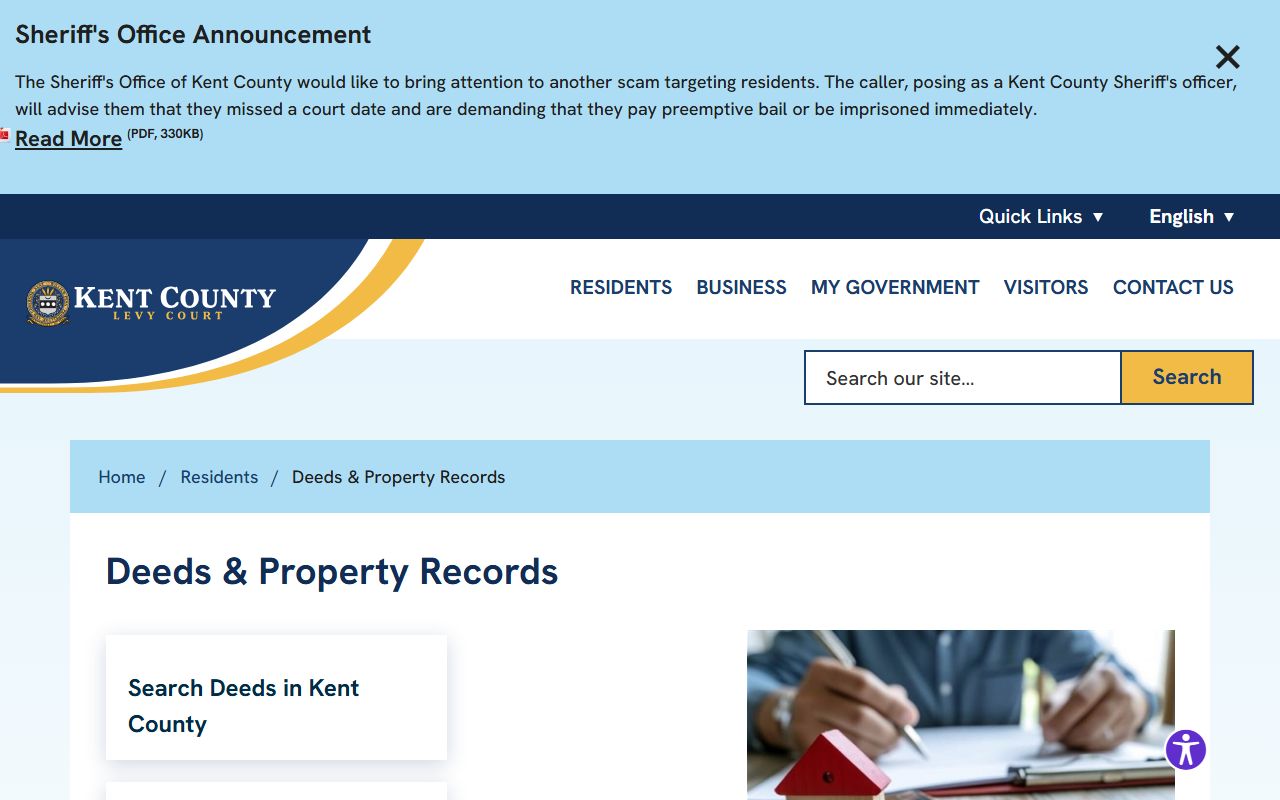
Kent County Recorder of Deeds provides deed and property record access for residents and researchers. Source: Kent County Resident Services.
For ownership data, sales prices, transfer dates, and assessment history on the Kent County side, the Kent County Levy Court property search is the right tool. You can search by address, owner name, or parcel ID. This database is separate from the deed index and focuses on current ownership and tax information rather than document images.
Note: Kent County deed records are available digitally from 1874 forward, but older documents may require an in-person visit to review original materials.
Sussex County Recorder of Deeds (South/East Milford)
Properties on the Sussex County side of Milford are recorded in Georgetown. The Sussex County Recorder of Deeds is Alexandra Reed Baker, and the office is at 2 The Circle, P.O. Box 827, Georgetown, DE 19947. Phone is (302) 855-7785 and email is deeds@sussexcountyde.gov. Office hours run from 8:30 AM to 4:30 PM Monday through Friday. The recording window closes at 4:00 PM. Get there before 4:00 PM if you need to file a document.
The Sussex County Recorder of Deeds also uses the US Land Records platform for online access. You can search the Sussex County online search portal for free. Downloads are $2.00 per page, with the same $75 monthly subscription option available. The system works the same way as the Kent County portal, but searches separate records.
The Sussex County Recorder of Deeds office in Georgetown handles deeds, liens, and other documents for the Sussex County portion of Milford. Online access is available through the US Land Records platform.
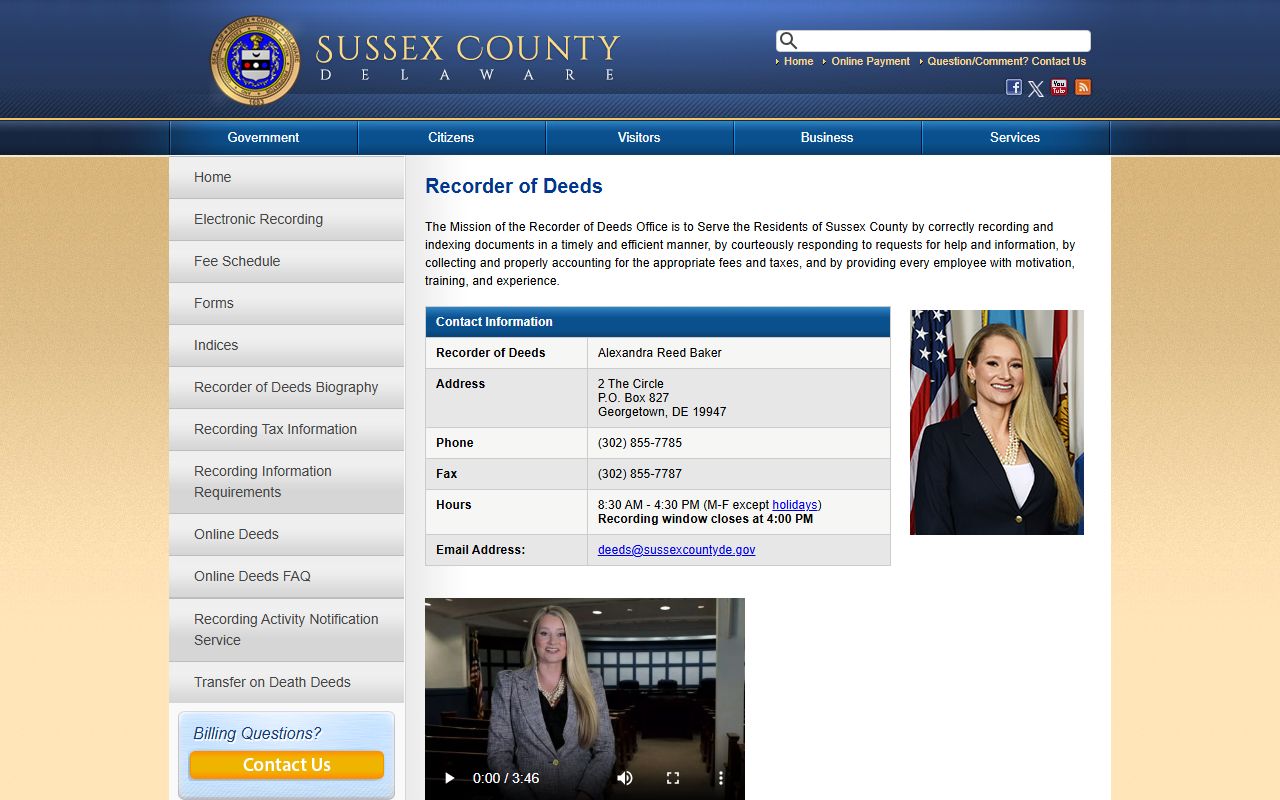
Sussex County Recorder of Deeds serves the south and east portions of Milford. Source: Sussex County Recorder of Deeds.
Sussex County is currently running a Property Reassessment Project. If you need assessment data for a Sussex County parcel in Milford, check the Sussex County Assessment Department for current values and reassessment updates. Values may be in flux as the project continues. This is worth knowing before you rely on an older assessment figure for any financial or legal purpose.
How to Determine Which County Your Milford Property Is In
This step comes first. Everything else depends on it. If you search the wrong county's records, you will not find what you are looking for. There are a few ways to find out which county holds a given Milford parcel.
The city's Planning and Zoning Department can identify which county a parcel is in. They maintain the city's zoning map, which tracks parcels across the county line. A phone call or a visit to city hall can get you an answer quickly. This is probably the most reliable approach for anyone unfamiliar with the boundary.
You can also try searching by address in both county systems. If you enter an address in the Kent County portal and get no results, try Sussex. This method works but it wastes time if you are searching the wrong place first. Better to confirm the county before you start searching. Prior deeds and tax records will also show the county name, so if you already have any documents for the property, check those first.
Subdivision plats for Milford properties are recorded in the county where the property is located. If you are researching a development or a new subdivision, the plat will be on file with either Kent or Sussex depending on which side of the line the lots fall. Some large developments near the boundary may have lots in both counties, which means separate plat recordings in each office.
Note: If a property straddles the county line itself, contact both recorders and the city planning department to understand how it is recorded and assessed.
City Departments That Keep Property Records
Milford's city departments do not record deeds, but they do maintain records that matter to property owners and researchers. Two departments are worth knowing about.
The Building Inspections Department issues permits and conducts inspections for all construction, renovation, and demolition within city limits. Permit records show what work has been done on a property, when it was done, and whether it passed inspection. Certificates of occupancy are issued after final inspections. These records can be important when buying or selling property, or when checking the history of improvements on a parcel. The department covers both the Kent and Sussex sides of the city since it operates citywide regardless of the county line.
The Planning and Zoning Department handles land use decisions, zoning variances, and development applications. Because Milford spans two counties, the department works with both Kent and Sussex on matters that cross county lines. If you need to know the zoning of a Milford parcel or review a past variance, this department holds those records. They also have access to the official zoning map, which is the most reliable tool for confirming which county a parcel is in.
Delaware Laws That Govern Property Records
Delaware property records are shaped by a set of state statutes that apply throughout the state, including Milford. Knowing the basic legal framework helps you understand what is in the records and what your rights are when searching or filing documents.
Delaware Code Title 9, Chapter 96 sets the rules for recording. All documents submitted for recording must include a parcel ID and a "prepared by" statement. Recorders of deeds are elected to four-year terms. This chapter governs the mechanics of how documents get into the public record, which means it applies to every deed and mortgage filed in both Kent and Sussex counties for Milford properties.
Title 25, Chapter 1 covers the rules for deeds and chain of title. This is the foundation of how property ownership transfers in Delaware. A deed must meet specific requirements to be valid and recordable. If a deed was not properly recorded, it may not be enforceable against a later buyer who had no notice of it. Understanding chain of title matters for anyone doing a title search on a Milford property.
Title 25, Chapter 2 introduced the Transfer on Death Deed in Delaware, effective 2025. This type of deed lets a property owner name a beneficiary who will receive the property at the owner's death without going through probate. A Transfer on Death Deed must be recorded in the county recorder's office where the property is located. For Milford properties, that means recording in either Kent or Sussex depending on which side of the line the property is on.
Title 30, Chapter 54 governs Delaware's Realty Transfer Tax, which is set at 3%. Milford receives a 1.35% share of the distributed proceeds. The transfer tax applies to most real estate sales and is typically split between buyer and seller. This tax is paid at the time of recording and is part of why recording fees vary by transaction size.
Title 6, Chapter 46 addresses fair housing and discriminatory covenants. Deed covenants that discriminate based on race, religion, or other protected classes are not enforceable under Delaware law. Property owners can request that such language be redacted from recorded documents. This does not erase the historical record but removes discriminatory text from the active copy on file with the recorder.
Note: Statute links go to the official Delaware Code site and reflect current law, though amendments may occur after publication.
What Milford Property Records Contain
Whether filed in Kent or Sussex, Milford property records cover the same basic categories. Deeds record ownership transfers. When a property changes hands, the deed goes to the county recorder and becomes part of the public record. The deed shows who sold, who bought, the legal description of the property, and when the transfer happened. Sales prices may or may not appear directly on the deed, but transfer tax records can often fill in that detail.
Mortgages and liens are also recorded. A lender who holds a mortgage on a Milford property files that document with the recorder to protect its interest. Contractors and other creditors can file mechanics' liens. Tax liens from unpaid property taxes appear in the record as well. A full title search should pull all of these to identify any claims against a property before a sale or refinance.
Assessment records sit with the county assessors, not the recorders. Kent County assesses its side and Sussex County assesses its side. These records show the assessed value used for property tax calculations. Both counties make their assessment data searchable online. The Kent Levy Court portal and the Sussex Assessment Department both offer public access to this information.
Building permits from the city's Building Inspections Department round out the picture. These records are citywide, not split by county. They show permit history, inspection results, and certificates of occupancy. A buyer doing due diligence on a Milford property should check both the county deed records and the city's permit records to get a complete picture of the property's history.
County Records Offices
Milford property records are filed with one of two county recorders depending on where the parcel is located. Both counties are linked below.
Nearby Cities
Other Delaware cities with property record pages nearby: